

CONTRIBUTORS

Chuck Royce
Chairman, Portfolio Manager

Francis Gannon
Co-Chief Investment Officer, Managing Director
What factors do you think helped the Russell 2000 Index to do so well in 3Q24 on both an absolute and relative basis?
Francis Gannon: I think it was a quintessential reversion to the mean event. Small-caps have been lagging larger companies for such an extended period that we weren’t surprised to see the significant rebound for the Russell 2000. The small-cap index was up 9.3% versus a 6.1% gain for the large-cap Russell 1000 and a 4.2% advance for the mega-cap Russell Top 50. The third quarter was therefore a long-awaited reversal in performance that we think has legs.
Chuck Royce: I think what surprised me most was how compressed the small-cap gains were. All of the third quarter’s positive return had been achieved by the sixteenth of July. That was the high for the quarter—a 10.6% advance from the end of June, and there was a substantial gain on that mid-July day. So, we saw a wonderful run through the first couple of weeks of 3Q24 followed by a steep downdraft. From July 16th though August 7th, the Russell 2000 fell -10.1% before recovering most of its gains through the end of September. Nonetheless, we were pleased with how small-caps did for the quarter. After all, the Russell 2000 last beat the Russell 1000 in the fourth quarter of 2023, so we were encouraged by the third quarter’s results
Are you concerned about the volatility within small-cap in 3Q24?
Chuck Royce: I’m not concerned about that for a couple of reasons. The first is that we always welcome volatility. While it can be painful in the short run, we always work to use volatility in stock prices to our long-term advantage. And as Joe Hintz recently pointed out when talking about technology stocks, we try to benefit from the market’s gyrations on both the upside—by trimming positions whose prices have run up in the short run while patiently waiting for a longer-term investment thesis to play out—and on the downside when prices fall to levels that we find attractive. The second reason is that large intra-year declines are really common. Over the last 25 years, that is, since 2000, the Russell 2000 has had a double-digit intra-year pullback in 22 of them. So, as long-tenured small-cap specialists, we know that volatility is part of the admission price of investing in the asset class.
What underlies your thinking in terms of how small-cap can sustain its nascent market leadership?
Francis Gannon: One trend that we’ve been watching is large-cap market breadth—because broadening large-cap markets have historically been a positive developments for small-cap leadership. Admittedly, this may sound a bit counterintuitive, at least initially. However, our research shows that when the equal-weighted Russell 1000 outperformed the capitalization-weighted Russell 1000, small-caps generally led. We think this is logical in that small-caps usually had market leadership when positive performance was more evenly distributed throughout the market. The equal-weighted Russell 1000 and S&P 500 both made new highs as September came to a close, and we see this expansion of returns as a positive sign for small-cap’s relative performance prospects.
How important is earnings growth for small-cap stocks going forward?
Francis Gannon: I would say they’re crucial because earnings really are the building blocks of long-term performance. We often say that psychology runs the market in the short term, but earnings run it over the long term. So, while any number of factors can help sustain a short-term run for small-caps, we think consistent and/or increasing earnings are key in sustaining long-term outperformance. At the end of September, the Russell 2000 had a near-record number of companies with no earnings, a total of 44.6%. Yet, earnings growth for those small-cap companies that have them is estimated to be higher than for large-cap businesses in 2025.
Small-Cap’s Estimated Earnings Growth is Expected to Be Higher Than Large-Cap’s in 2025
One-Year EPS Growth
As of September 30, 2024
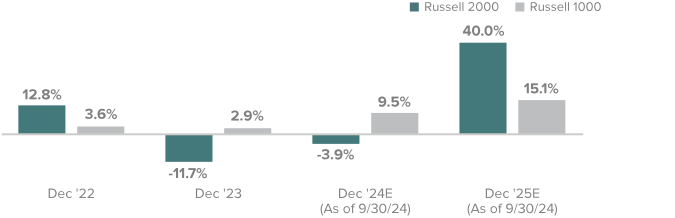
Source: FactSet. Earnings per share (EPS) is calculated as a company’s profit divided by the outstanding shares of its common stock. The EPS Growth Estimates are the pre-calculated mean one-year EPS growth rate estimates by brokerage analysts. Estimates are the average of those provided by analysts working for brokerage firms who provide research coverage on each individual security as reported by FactSet. All non-equity securities, investment companies, companies without brokerage analyst coverage are excluded. There is no assurance that any estimate, forecast or projection will be realized. Past performance is no guarantee of future results.
Why are consistent and/or high returns on invested capital (“ROIC”) such an important part of your analysis of small-cap companies?
Chuck Royce: We place a great deal of emphasis on company quality in a few of our major Strategies. You could say that ROIC is in our collective DNA in those portfolios because we’ve always seen it as foundational to any investment approach that puts a premium on company quality. Along with free cash flow, ROIC tells us a lot about management’s skill at allocating capital—which is critical when looking for companies that can compound value over time. Small-cap companies with consistent, or consistently high, ROIC are usually in relatively short supply, so populating portfolios with high-quality, high ROIC companies can also be a highly effective way of running actively managed small-cap portfolios.
Francis Gannon: We devote a lot of research on how to best mitigate risk within small-cap—that’s also important to highlight as a potential benefit of active management. We want to sleep well at night and certainly want our investors to sleep well. So, in our quality portfolios we’re looking for what we consider ‘better businesses’—that is, companies with little or no debt and established histories of high and consistent ROIC. Our research makes it clear that these kinds of companies tend to be less volatile than most other small-cap stocks while also having the potential to generate market-beating returns over the long run.
How significant a factor are falling rates for the health of the market and/or the economy?
Chuck Royce: I think falling rates are less important than the normalization of rates. After the last few years when rates rose at such a breakneck pace, we’re now in a period where both the level and rates of change are more in line with long-term historical averages. It’s true that the first rate cut provided a boost, but it was short lived, which was not surprising, mostly I think because much of the market had already priced in a reduction. One area that I think will benefit from lower rates going forward, however, is M&A activity. There’s been a lot of money on the sidelines as potential buyers were waiting for the Fed to act before moving forward on making acquisitions. And because many small-caps often have the ‘urge to merge,’ I think we’re likely to see more strategic buys over the next several months.
What impact, if any, do you think the election will have on small-cap stocks?
Francis Gannon: This is a question every asset manager is asked during presidential election cycles, so we ran the data and found that small-caps had better returns than large-caps following the last 10 presidential elections. What’s interesting is that this has been the case regardless of which party wins the White House or whether or not the president’s party also won congressional majorities. It’s also held true even though every election cycle has its own set of challenges, difficulties, and opportunities. What this suggests to us is that it’s not so much about the person or policies as much as it’s about an end to the uncertainty that’s tends to pervade the months before any election.
Historically, Presidential Election Years Have Been Positive for Small-Caps
Average Total Returns for the Russell 2000 and Russell 1000 After the Last 10 Presidential Elections
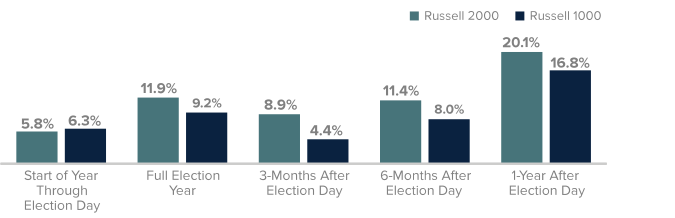
Source: Russell Investments. Past performance is no guarantee of future results.
How do you develop areas of interest or themes within small-cap?
Chuck Royce: We always start at the bottom. Any themes or overarching ideas almost always originate with a few names that screen well for quality and/or inexpensive valuation. Our rigorous research process then often uncovers competitors or customers that also attract our interest. This probably happens most often when we own a company that sells innovative products or services which then leads us to investigate the ecosystem in which that company operates. But we don’t start with a theme. It always begins with the individual company and proceeds from there.
What is your outlook for small-cap stocks?
Francis Gannon: Our outlook is cautious but constructive. There is plenty to concerned about: wars in the Ukraine and the Middle East, the dockworkers’ strike, and another highly contentious election season. However, there are also significant positives: inflation continues to moderate, the economy is growing, unemployment is low, and rates have normalized. We’re also beginning to see the benefits of reshoring, the CHIPS Act, and various infrastructure projects. In addition, there’s a positive reversion to the mean argument for small-cap leadership and strong performance. The Russell 2000 finished 3Q24 down -4.7% since the previous small-cap peak on 11/8/21, even as large-caps continued making new highs into the end of September. And the small-cap index’s annualized 3-year return for the period ended 9/30/24 was 1.8%. Historically, small-cap performance has been quite strong following previous periods of low or negative performance. As we show in the chart below, these periods of below average performance were followed by periods of higher-than-average returns.
99% of the Time, Positive 3-Year Returns Have Followed Low Return Markets
Subsequent Average Annualized 3-Year Performance for the Russell 2000 Following 3-Year Annualized Return Ranges of Less Than 3%, 12/31/81-9/30/24
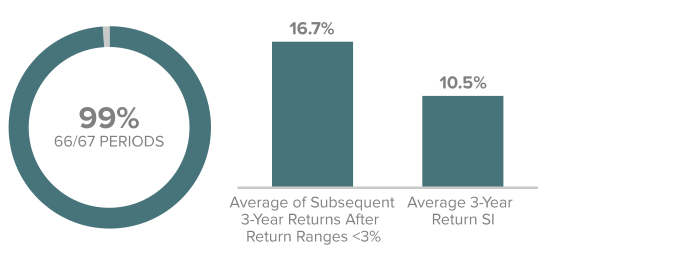
Source: Russell Investments. Past performance is not an indicator or a guarantee of future performance.
Finally, we want to reiterate that an opportunity exists for investors to build their small-cap allocation at attractively low and/or reasonable prices—and we believe the current period is an opportune time to invest in select small-caps for the long run.
Definitions
The Russell 1000 Index is an unmanaged, capitalization-weighted index of domestic large-cap stocks. It measures the performance of the 1,000 largest publicly traded US companies in the Russell 3000 Index.
The Russell 2000 Index is an index of domestic small-cap stocks that measures the performance of the 2,000 smallest publicly traded US companies in the Russell 3000 Index.
The Russell 2000 Value and Growth indexes consist of the respective value and growth stocks within the Russell 2000 as determined by Russell Investments.
The Russell Top 50 Index also known as the Russell Top 50 Mega Cap is a stock market index that measures the performance of the largest companies in the Russell 3000 Index. The Russell 3000 Index is a capitalization-weighted stock market index that seeks to be a benchmark of the entire US stock market.
The Standard & Poor’s® 500 Index (S&P 500®) is a market capitalization-weighted index of 500 stocks designed to measure total US equity market performance.
Outperformance cycles normally consider the stock performance of small-caps versus large caps. Small-cap stocks historically have outperformed large-cap stocks but are also more volatile and riskier.
Enterprise value (EV) refers to the entire value of a company after taking into account both holders of debt and equity.
The EV/EBIT multiple is the ratio between enterprise value (EV) and earnings before interest and taxes (EBIT).
The CHIPS and Science Act (CHIPS Act) is a US federal statute enacted by the 117th United States Congress and signed into law by US President Joe Biden on August 9, 2022. The act provides roughly US$280 billion in new funding to boost domestic research and manufacturing of semiconductors in the United States.
WHAT ARE THE RISKS?
All investments involve risks, including possible loss of principal. Past performance is no guarantee of future results. Please note that an investor cannot invest directly in an index. Unmanaged index returns do not reflect any fees, expenses or sales charges.
Equity securities are subject to price fluctuation and possible loss of principal.
Commodities and currencies contain heightened risk that include market, political, regulatory, and natural conditions and may not be suitable for all investors.
Small- and mid-cap stocks involve greater risks and volatility than large-cap stocks.
US Treasuries are direct debt obligations issued and backed by the “full faith and credit” of the US government. The US government guarantees the principal and interest payments on US Treasuries when the securities are held to maturity. Unlike US Treasuries, debt securities issued by the federal agencies and instrumentalities and related investments may or may not be backed by the full faith and credit of the US government. Even when the US government guarantees principal and interest payments on securities, this guarantee does not apply to losses resulting from declines in the market value of these securities.
Any companies and/or case studies referenced herein are used solely for illustrative purposes; any investment may or may not be currently held by any portfolio advised by Franklin Templeton. The information provided is not a recommendation or individual investment advice for any particular security, strategy, or investment product and is not an indication of the trading intent of any Franklin Templeton managed portfolio. Past performance does not guarantee future results.
Any data and figures quoted in this article sourced from Russell Investments, FactSet, Bloomberg and Reuters.
Important data provider notices and terms available at www.franklintempletondatasources.com. All data is subject to change.